

Thin-Film vs Fractional Distillation vs Hydrotreating: Which Route Fits Your Feed?
A re-refining plant is usually described by its main unit: thin-film evaporator, distillation column or hydrotreater. The unit matters less than the order in which the stages are chosen. Feed data and product specification set the route; equipment follows.
Table of Contents ▴
Four Stages, Four Jobs
| Stage | What it does | What it does not do |
|---|---|---|
| Thin-film or short-path evaporation | Separates volatile oil from heavy residue at low temperature and short residence | Does not cut a narrow boiling range or finish the product |
| Fractional distillation | Splits the distillate into boiling-range cuts | Does not remove sulfur, nitrogen or colour bodies |
| Solvent extraction (NMP) | Removes aromatics and polar compounds and improves viscosity index and colour | Does not remove light ends or lift quality beyond the feed |
| Hydrotreating | Removes sulfur, nitrogen and oxygen and saturates unstable compounds | Does not fix a feed with chlorine, metals or heavy residue |
Thin-Film Evaporation Is a First Separation Step
Thin-film and short-path evaporators put the feed into a thin layer against a heated wall under vacuum. The film spends seconds, not hours, at temperature, so heavy and heat-sensitive oils can be separated with less cracking and less fouling than in a batch column.
The output is a distillate fraction. It is not a finished base oil and it is not a set of cuts. Where a project needs several viscosity grades, fractionation follows the evaporator.
Fractional Distillation Sets the Cuts
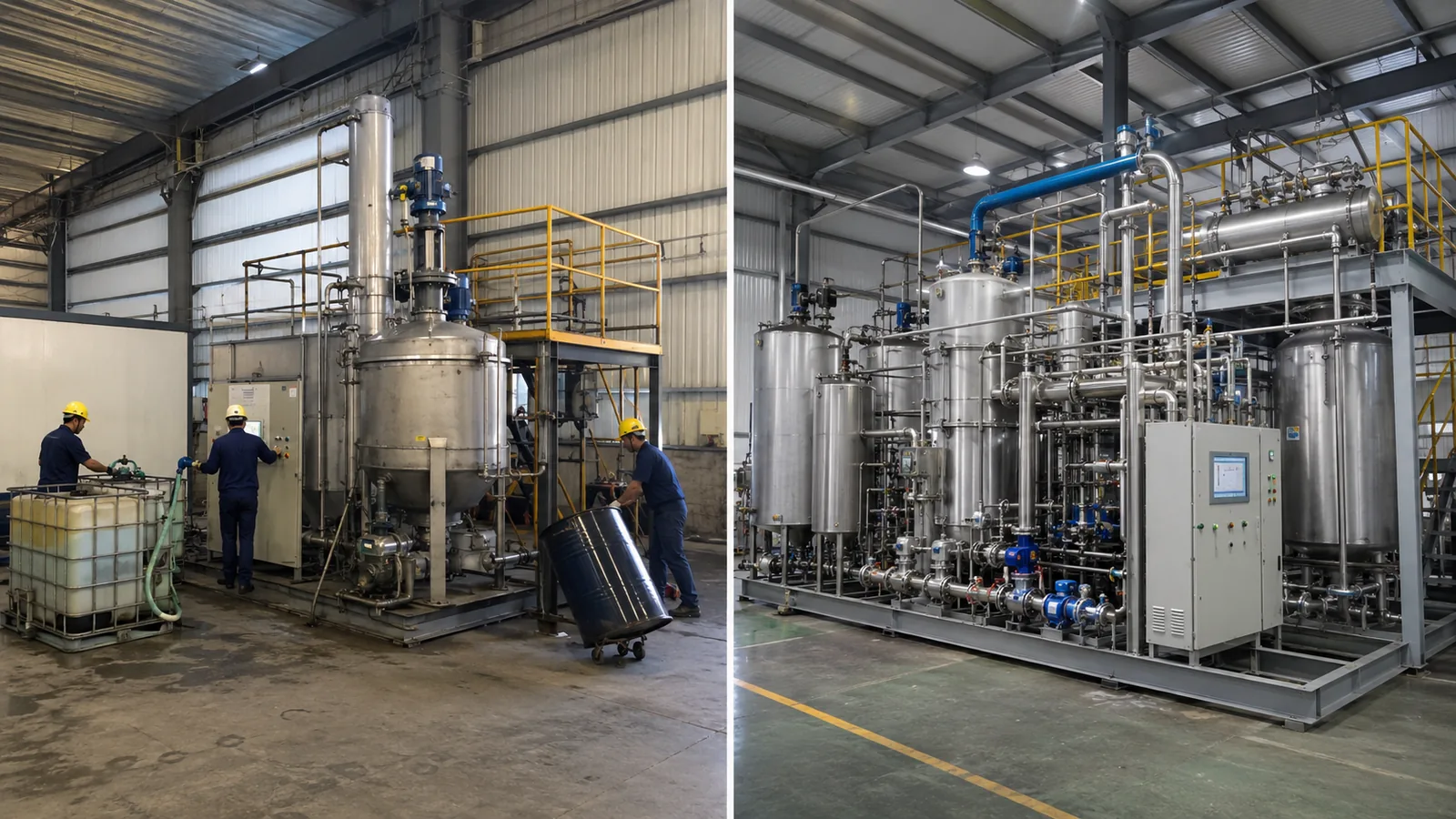
A fractionation column splits the distillate into boiling ranges such as SN150, SN350 and SN500. Cut points depend on reflux ratio, pressure and the composition of the feed. When the feed changes, the cuts move unless the operating conditions are adjusted.
Fractionation does not remove sulfur, nitrogen or colour bodies. If the product specification includes those limits, a finishing stage is part of the route, not an optional extra.
Solvent Extraction and Hydrotreating
Solvent extraction is a physical separation. N-methyl-2-pyrrolidone (NMP) removes aromatics and polar compounds, improving viscosity index and colour, and produces an extract stream that has to be handled. It needs no hydrogen and no catalyst.
Hydrotreating is a chemical step. It removes sulfur, nitrogen and oxygen and saturates unstable compounds, and can push a product toward Group II or Group III. It needs hydrogen, a catalyst and a feed clean enough to protect that catalyst. Chlorine and metals shorten catalyst life; pretreatment is part of the hydrotreating decision, not a separate one.
For the extraction route in more detail, see base oil solvent extraction plant. The equipment scope for the full train is described in used oil re-refining base oil equipment.

A Five-Step Decision Sequence
- analyze a representative feed, including water, solids, chlorine and metals;
- define the product specification and the grade to be claimed;
- set the pretreatment depth the feed requires;
- choose the separation route: thin-film, fractional distillation or both;
- choose the finishing route: solvent extraction, adsorption, hydrotreating or a combination.
The order matters. A hydrotreater selected before the feed is tested, or a fractionation column selected before the product grade is defined, usually ends in a scope change after the quotation.
Feed properties decide more of the route than the equipment list does. The tests that matter are covered in used oil testing before re-refining, and the grade definitions in re-refined base oil standards.
What to Ask a Supplier
- Which stage does the quotation start and stop at?
- What feed envelope is the design based on?
- Is the finishing step included, and what product specification does it meet?
- Where do the extract and residue streams go?
- What acceptance test defines success for the whole train?
Two quotations can both say "base oil plant" and cover different stages. The comparison only works when each answer refers to the same feed, the same product and the same boundary. Project scope is covered in turnkey used oil re-refining plant.
Choosing a Re-Refining Route?
Send the feed analysis and the product specification. We will show which stages the feed requires, which are optional, and where the boundary of the equipment scope should sit.
Order & Project Support
Frequently Asked Questions
Can a thin-film evaporator replace fractional distillation?
No. The evaporator separates volatile oil from residue. Fractionation produces the individual boiling-range cuts. Most multi-grade projects need both.
Is hydrotreating always required for Group II base oil?
It depends on the feed and the measured sulfur and saturates. Some feeds reach the limits with solvent extraction and adsorption; others need hydrotreating. The grade is confirmed by testing the product.
Which route is the cheapest?
There is no universal answer. A simpler route can be cheaper to build and more expensive per tonne if it produces a lower-value product or needs more pretreatment. Compare the installed scope against the same feed and product specification.