





The Journey of Waste Oil to Base Oil: Distillation Equipment in Used Engine Oil Refining
From Used Oil to Base Oil: What Distillation Does and Does Not Do
Used-oil re-refining is a sequence of feedstock preparation, separation and finishing steps. Distillation can recover lubricant-range fractions from used engine oil, but it does not by itself guarantee a finished base-oil grade. The required process depends on the incoming oil, the target specifications, laboratory results and local rules for products and residues.
Start with Feedstock Characterization
Representative sampling should establish water, suspended solids, ash, metals, halogens, sulfur, viscosity, acidity, additive degradation and boiling behavior. Mixed collections can vary widely, so an equipment proposal based only on a generic label such as “used engine oil” carries avoidable technical and commercial risk.
Process Route: Pretreatment, Vacuum Distillation and Finishing
A project-specific route may include the following stages. Each stage should be identified as included, optional or outside the equipment supplier’s scope:
Feedstock preparation: Settling, screening, filtration and controlled dewatering reduce free water and solids before the main separation step.
Dehydration and light-ends removal: Water and low-boiling contaminants are removed under controlled temperature and pressure before lubricant fractions are collected.
Vacuum distillation: Reduced pressure separates lubricant-range fractions at lower boiling temperatures while limiting thermal stress. Heavy residue, water and non-condensable process gas remain separate mass-balance categories.
Finishing: Solvent extraction, hydrotreating, adsorption or other polishing methods may be considered according to the target properties. No single finishing step is suitable for every feedstock or market.
Base-oil Group I, II or III classification must be supported by the applicable measured properties and classification rules. It cannot be assigned from equipment type, oil color or a supplier’s marketing description, and distillation alone does not establish the group.
Equipment Scope Buyers Should Compare
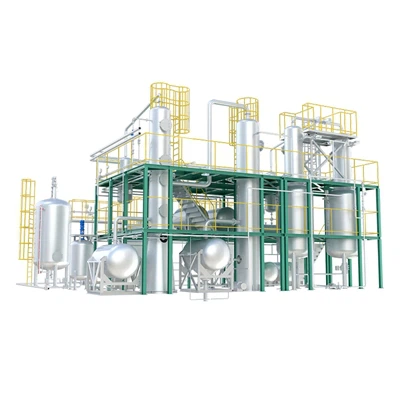
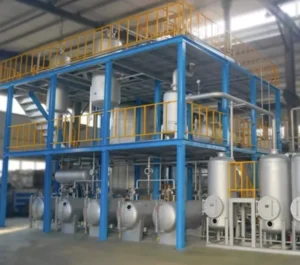
A complete comparison should cover the main process equipment, utilities, controls, environmental interfaces and battery limits rather than only the distillation vessel:
Pretreatment and feed system: Feed tanks, filtration, dewatering, pumps and metering sized for the actual contaminant load.
Vacuum and heat-transfer system: Vacuum generation, heat exchangers, heaters and temperature controls designed for stable separation and manageable fouling.
Fractionation and condensation: Separation stages, condensers, receivers and storage arrangements matched to the planned product cuts.
Finishing and filtration: The selected post-treatment, final filtration and sampling points required by the approved product test plan.
Instrumentation should show critical temperatures, pressures, vacuum and flow conditions, with alarms and interlocks defined for the operating philosophy. The quotation should also state which tanks, cooling systems, piping, emission controls, installation services, commissioning duties and spare parts are included.
Product Testing, Residues and Project Acceptance
Project acceptance should be based on representative feedstock, an agreed operating window, a documented test method and clearly allocated responsibilities. Appearance can be recorded, but color alone does not establish base-oil quality or suitability for lubricant blending.
Product testing: Depending on the target, the laboratory plan may include kinematic viscosity, viscosity index, flash point, pour point, sulfur, total acid number, water, ash, carbon residue and other buyer or market specifications.
Mass balance: Recovered lubricant fractions, lighter fractions, separated water, non-condensable gas and heavy residue should be identified. Any yield is an engineering estimate tied to stated feedstock assumptions, not a guaranteed saleable base-oil output.
Residues and emissions: Storage, testing, transport, treatment and disposal or recovery routes must follow site permits and local requirements. Heavy residue should not be assumed to be a commercial product.
Recovered base-oil fractions are not automatically finished automotive lubricants. Lubricant production normally requires an approved formulation, compatible additives, controlled blending and batch release testing for the intended application.
What to Send for a Project Review
Provide a representative feedstock analysis, available quantity, target product specifications, planned capacity, utilities, site conditions, local compliance requirements and intended residue routes. VBOLT can then review a suitable configuration and define the limits of supply. See the used-oil re-refining equipment page as a starting reference; final performance and acceptance criteria belong in the signed project documents.