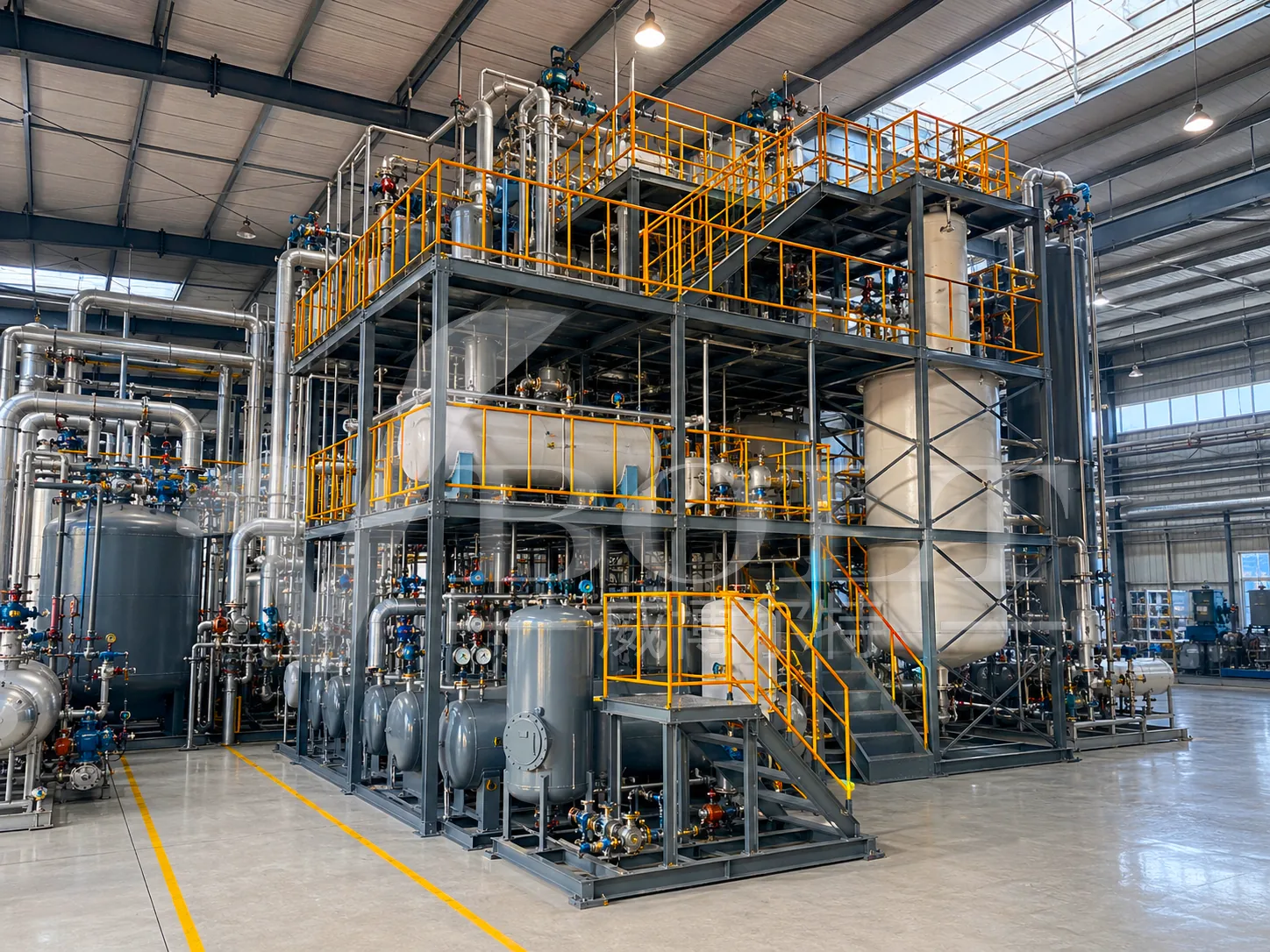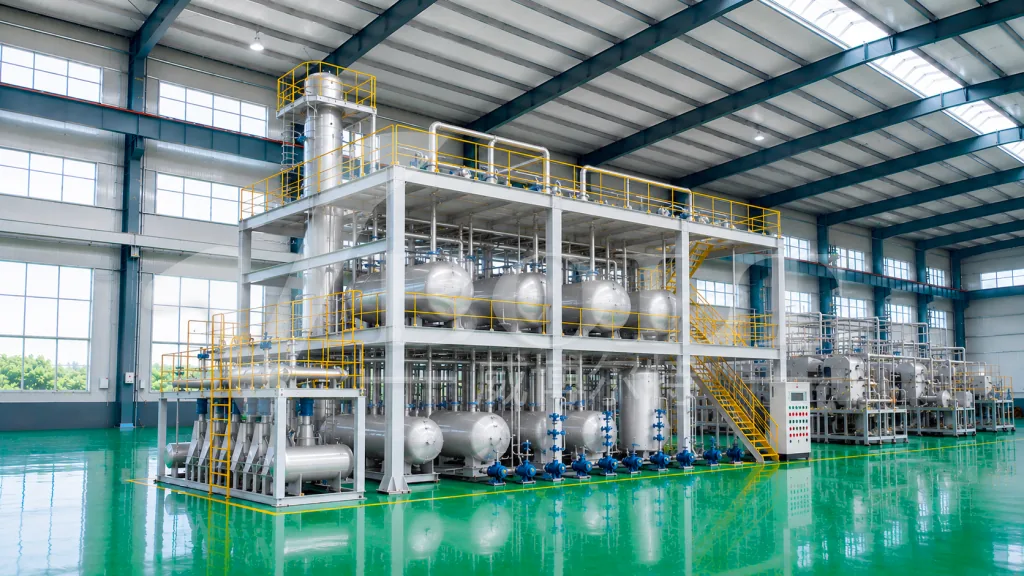



Turnkey Used Oil Re-Refining Plant: Complete Equipment Scope, Utilities and Project Delivery
A turnkey used oil re-refining plant should not be purchased by comparing the main distillation unit alone.
For an industrial re-refining project, the final plant scope is determined by five practical inputs: feedstock condition, target base oil, sustainable processing capacity, available utilities and site execution conditions.
Two quotations may both be described as a 10 TPD plant while covering very different equipment and project responsibilities. One may stop at pretreatment and vacuum distillation, while another includes fraction recovery, finishing, residue handling, automation and commissioning support.
Defining the process basis and responsibility boundaries before freezing the equipment list makes quotations easier to compare and reduces interface problems at installation.
Table of Contents ▴
A Turnkey Re-Refining Project Starts With the Process Basis
The first technical decision should not be the size of the vacuum distillation unit. It should be the condition of the oil that will actually enter the plant.
Used engine oil and other accepted lubricant streams vary in water, sludge, solids, viscosity, light fuel contamination, additives, ash and metals. Those differences drive pretreatment load, vacuum operation, residue generation and finishing requirements.
The process route should therefore follow representative feedstock information rather than the general description “used oil.” Before confirming a used oil re-refining project, the key questions are:
- What are the main feedstock sources, and how stable is the feed from month to month?
- What water and sludge conditions should pretreatment handle?
- Which base oil fractions are required, and is downstream finishing needed?
- How much prepared feed is sustainably available each day?
Where feedstock condition is still uncertain, the first step is to review existing test data. Our article on used oil testing before re-refining covers the parameters that matter most for equipment selection.
Complete Process Equipment Scope
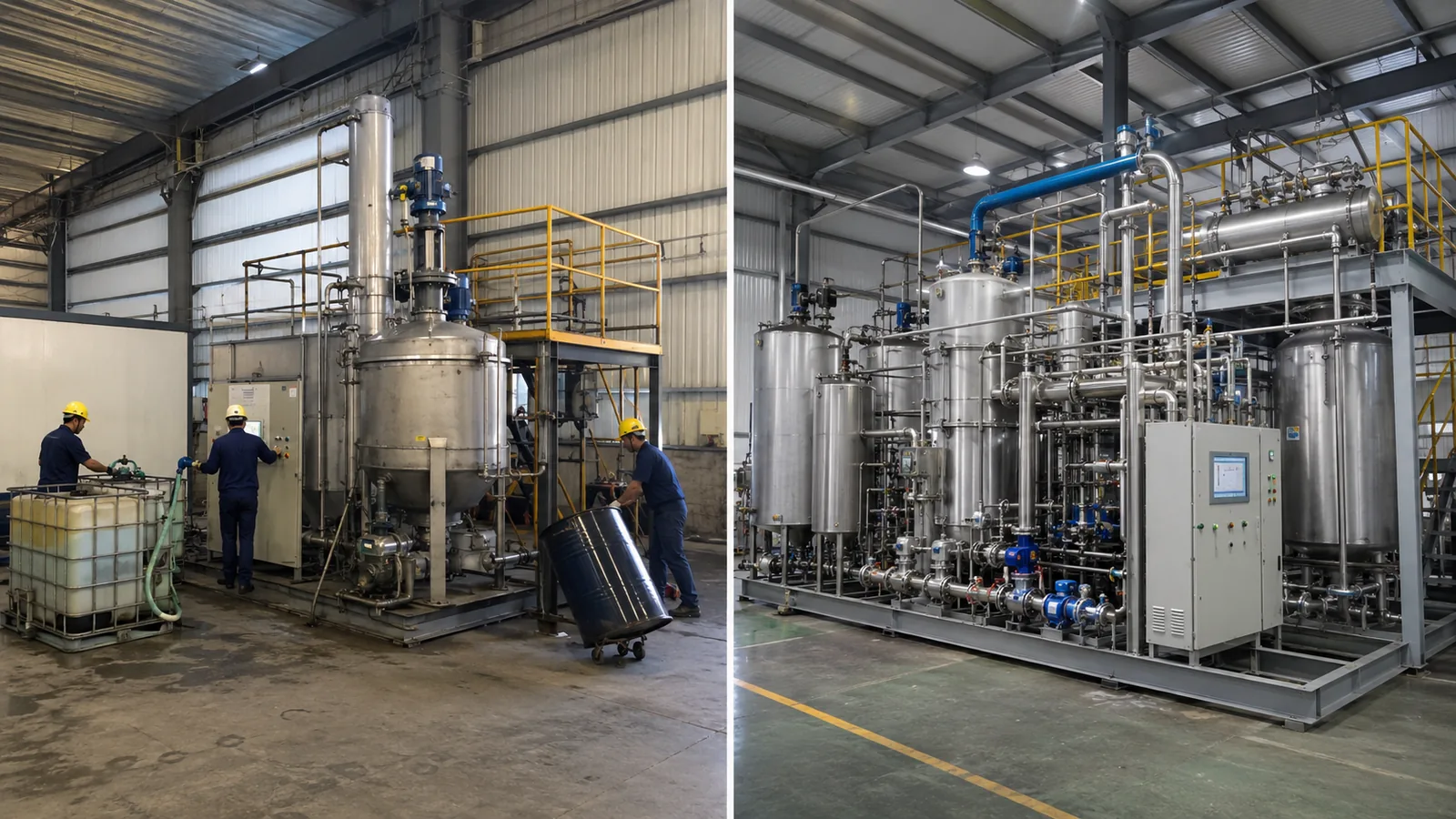
A complete turnkey used oil re-refining plant can contain several process sections. The final combination should follow the actual feedstock and base oil target rather than a fixed package.
| Process Section | Project Function | Scope to Confirm |
|---|---|---|
| Feed receiving | Receives and buffers incoming used oil | Tank capacity, segregation and transfer arrangement |
| Pretreatment | Removes free water, coarse solids and unsuitable material before the main process | Settling, filtration and separation requirements |
| Dehydration / light-end removal | Prepares feed for stable downstream separation | Feed water basis and required pretreatment capacity |
| Vacuum distillation | Separates recoverable lubricant-range fractions from heavier material | Feed condition, operating basis and capacity |
| Fractionation | Separates selected oil fractions according to the project target | Required product cuts and operating control |
| Base oil finishing | Further treats recovered oil where required by the product specification | Finishing route and target properties |
| Residue handling | Collects and transfers heavy process residue | Discharge method, storage and local handling |
| Control system | Controls major process parameters and interlocks | PLC, instrumentation, alarms and remote functions |
For base oil projects, this distinction matters because vacuum separation and finished base oil production are not automatically the same scope.
Depending on the project, the downstream route can include additional refining or finishing. Buyers should therefore confirm whether a quotation stops at recovered distillate or includes the equipment required for the agreed finished product target.
For the complete re-refining route, see our Used Oil Re-Refining Base Oil Equipment.
Utilities That Must Be Confirmed Before Final Design
Equipment selection and utility design cannot be separated.
A plant designed around one cooling-water temperature, electrical supply or heating source will not perform identically at a site with different utility conditions.
Before final engineering, we need the site conditions for:
- electrical voltage, frequency and available capacity;
- heating energy source;
- cooling-water supply and temperature, plus process water where required;
- compressed air, drainage and wastewater handling;
- ambient temperature and local climate conditions.
These figures influence condenser sizing, heating configuration, vacuum stability, layout and the operating schedule.
Two apparently similar used oil re-refining plant quotations should not be compared until the utility design basis is clear.
Battery Limits and Project Responsibilities
The word “turnkey” should never replace a written responsibility matrix.
For international projects, part of the plant may be supplied by the equipment manufacturer while civil work, site utilities, local piping and regulatory systems are completed by the buyer or local contractor.
These battery limits should be defined before manufacturing starts.

| Project Item | Typical Scope Question |
|---|---|
| Process equipment | Which vessels, columns, pumps, condensers, filters and auxiliary systems are included? |
| PLC / instrumentation | Which instruments, control cabinets and field devices are supplied? |
| Tank farm | Are feed, intermediate and product tanks included or locally supplied? |
| Foundations | Who provides foundation design data and who performs the civil work? |
| Heating system | Is the heating source included and what site fuel or energy is required? |
| Cooling system | Who provides cooling towers, pumps and distribution piping? |
| Main electrical distribution | Where does the equipment supplier's electrical boundary end? |
| Local piping | Which interconnecting pipelines are included? |
| Fire protection | Which systems must be designed to local regulations? |
| Wastewater handling | Where is the process discharge boundary? |
| Installation labor | Does the buyer provide local workers, lifting equipment and tools? |
| Commissioning | What supplier support is included and what must be ready before arrival? |
Clear battery limits prevent a common problem: equipment arrives on site while several connections were assumed to be someone else's responsibility.
The objective is not to label every project with the same turnkey scope, but to identify included supply, exclusions, interface points and buyer responsibilities clearly enough to move from shipment to installation without gaps.
Manufacturing, Inspection and Documentation
A commercial base oil re-refining plant should also have an agreed inspection and documentation basis.
Depending on the equipment and project requirements, manufacturing control can include:
- material verification and fabrication inspection;
- welding checks and pressure or leak testing where applicable;
- equipment assembly and electrical inspection;
- instrument, control and functional checks;
- packing inspection and final shipment documentation.
Material certificates, welding records, witness points, factory acceptance testing or third-party inspection should be identified during technical clarification, not after fabrication.
This is where a project-based equipment manufacturer differs from a machine seller: the equipment list, inspection plan and documentation package follow the actual project.
Installation and Commissioning Planning
Installation planning should begin before the equipment is shipped.

The site should already have the required information for:
- equipment layout, foundation positions and loads;
- lifting and access routes;
- main process piping, utility and electrical interfaces;
- local labor planning and equipment storage before erection;
- installation sequence.
For overseas projects, “installation support” also needs a defined boundary. The contract should clarify who supplies local workers, cranes, welding tools, insulation work, piping materials, accommodation and site utilities.
Commissioning then begins only after the plant has the required utilities and suitable prepared feed.
A proper commissioning sequence typically covers instrument checks, pump and transfer tests, vacuum and heating checks, controlled feed introduction, process stabilization, product sampling and operator training.
The objective is not to confirm that individual motors and pumps run, but that the complete re-refining process operates under the agreed project conditions.
Performance Acceptance Should Be Defined Before Manufacturing
Performance acceptance should be agreed before the order, not negotiated after startup.
The acceptance basis should define:
- agreed feedstock or feed envelope;
- prepared-feed condition and utility conditions;
- operating period and stable feed rate;
- mass balance, recovered product fractions and residue quantity;
- sampling procedure and laboratory test method;
- agreed product specification.
This prevents vague acceptance terms such as “high yield,” “premium base oil” or “10 TPD capacity” being interpreted differently by the buyer and supplier.
A nominal plant capacity should be evaluated under the agreed feed and operating basis, not treated as the same tonnage of finished saleable base oil.
The same principle applies to product quality: re-refined base oil should be evaluated against agreed laboratory parameters, not visual color alone. For more detail, see Re-Refined Base Oil Quality: What Buyers Should Confirm.
What Buyers Should Send Before Requesting a Turnkey Proposal
An RFQ that only says “Please quote a 10 TPD used oil re-refining plant” is not enough to prepare a reliable project scope.
A useful RFQ should cover:
- main used oil types and feedstock sources;
- representative feed test data;
- daily and monthly available feed volume;
- water, sludge, viscosity and known contamination;
- required base oil target and planned operating hours;
- site voltage and frequency, heating source, cooling water and compressed air;
- available plant footprint and required automation level;
- installation and commissioning expectations, plus local inspection or regulatory requirements.
The more precisely these conditions are defined, the easier it is to compare the engineering scope rather than only the quotation price.
For preliminary capacity planning, buyers can also review our 5, 10 or 20 TPD Waste Oil Recycling Plant Capacity Guide.
VBOLT Project Delivery Approach
For us, a turnkey used oil re-refining plant is handled as an engineering project rather than an isolated equipment order.
The project can progress through the following sequence:
| Project Stage | Main Work |
|---|---|
| 1. Feedstock review | Review available oil data and identify the expected feed envelope |
| 2. Product target | Confirm required base oil fractions and finishing objective |
| 3. Process selection | Match pretreatment, separation and finishing to the project basis |
| 4. Scope clarification | Define equipment, utilities, interfaces and exclusions |
| 5. Layout and utility review | Match the plant to actual site conditions |
| 6. Manufacturing | Fabricate and assemble equipment according to the confirmed scope |
| 7. Inspection | Complete applicable manufacturing and functional checks |
| 8. Shipment preparation | Complete packing, documentation and delivery planning |
| 9. Installation planning | Coordinate site readiness and equipment interfaces |
| 10. Commissioning support | Support process startup under agreed site and feed conditions |
| 11. Operator training | Transfer operating and maintenance requirements to the plant team |
The purpose of this sequence is to resolve technical and commercial interfaces before they become site problems.
This is particularly important for international used oil re-refining plant projects, where civil work, utilities, local contractors, inspection requirements and environmental regulations can vary significantly between countries and sites.
Planning a Turnkey Used Oil Re-Refining Project?
Send us your feedstock information, representative test data, available volume, required base oil target, planned plant capacity, utility conditions and site information.
We can review the process route, equipment scope, utility interfaces, battery limits and commissioning requirements before preparing the final project proposal.
Order & Project Support
Frequently Asked Questions
Does a turnkey used oil re-refining plant automatically include civil work?
No. Foundations, buildings, local infrastructure and regulatory systems may remain buyer or local-contractor responsibilities unless they are specifically included in the agreed project scope. The responsibility matrix should be confirmed before manufacturing.
Is vacuum distillation alone enough to produce finished base oil?
Not in every project. The required finishing route depends on the recovered fractions, feedstock condition and target base oil specification. Some projects require additional refining or finishing after vacuum separation.
What information is needed for a turnkey re-refining plant quotation?
The most useful information includes feedstock type, representative test data, available feed volume, target base oil, required capacity, operating hours, utilities, site conditions and the required installation and commissioning scope.
Who normally provides utilities during commissioning?
Site utilities and commissioning feed are normally provided according to the agreed responsibility matrix. For international projects, buyers should confirm electricity, heating, cooling water, compressed air and suitable feedstock before the commissioning team arrives.
How should re-refining plant performance acceptance be defined?
Acceptance should use agreed feedstock conditions, utilities, operating period, throughput basis, mass balance and laboratory test methods. This provides a measurable basis for evaluating plant performance instead of relying on general claims about yield or product quality.