





Waste Oil Recycling Plant Supplier: Equipment, Engineering and Project Capabilities Buyers Should Compare
Comparing a waste oil recycling plant supplier only by equipment price can produce a misleading result.
Two suppliers may both quote a 10 TPD plant, but they may not be designing around the same feedstock, product target, operating hours, utility conditions or project boundary.
For industrial buyers, the more useful comparison is not “Which supplier offers the lowest price?” but “Which supplier has defined the same feedstock basis, process route, equipment scope, utilities, project responsibilities and measurable acceptance conditions?”
At VBOLT, we treat this as an engineering comparison rather than a catalogue-machine comparison. Our waste oil recycling projects are configured from representative feed data, target product requirements, verified feed capacity, utilities and site conditions.
Table of Contents ▴
The Same TPD Rating Does Not Mean the Same Plant
A capacity figure such as 5 TPD, 10 TPD or 20 TPD is useful only when the operating basis behind that figure is clear.
Before comparing quotations, buyers should confirm:
- what feedstock the quoted capacity is based on, and whether it is wet feed or prepared feed;
- how many operating hours per day are assumed, and whether pretreatment and batch changeover time are included;
- what utility conditions are assumed;
- what downstream product the plant is configured to produce.
A supplier quoting “10 TPD” for stable prepared lubricating oil is not necessarily offering the same basis as one designing for variable mixed waste oil with more water and sludge.
For preliminary sizing, buyers can review our 5, 10 or 20 TPD Waste Oil Recycling Plant Capacity Guide.
Compare the Feedstock Basis First
A serious waste oil recycling equipment manufacturer should ask for feedstock information before making strong claims about capacity, recovery or final product.

Useful feed information can include:
- used oil type, source and batch-to-batch consistency;
- water content, sludge and suspended solids;
- viscosity and light fuel contamination;
- sulfur, chlorine, ash, carbon residue and metals where relevant;
- monthly and daily available volume.
Feedstock variability can change pretreatment requirements, residue loading, stable operating time and the amount of prepared feed available to the main processing section.
This is why the phrase “waste engine oil” or “mixed waste oil” alone is not enough for a final equipment configuration.
For projects sourcing oil from several collectors or industrial sites, our article Why Waste Oil from Different Suppliers Can Cause Big Differences in Daily Plant Throughput explains how feed consistency changes actual plant utilization.
Confirm the Process Route and Product Target
A waste oil recycling plant should not be selected before the intended product route is clear.
For waste oil processing, VBOLT's projects fall into two main route directions:
| Project Route | Main Objective | Typical Engineering Focus |
|---|---|---|
| Waste oil to diesel-range fuel fractions | Recover controlled boiling-range fuel fractions from suitable waste oils | Pretreatment, dehydration, vacuum separation, fractionation and finishing selected from feed-test data |
| Used oil re-refining to base oil | Recover lubricant-range fractions for further base oil processing | Pretreatment, vacuum distillation, fraction control and downstream refining / finishing |
These two routes are not interchangeable. Feed composition, intended product, applicable specifications and local requirements should determine the final process configuration.
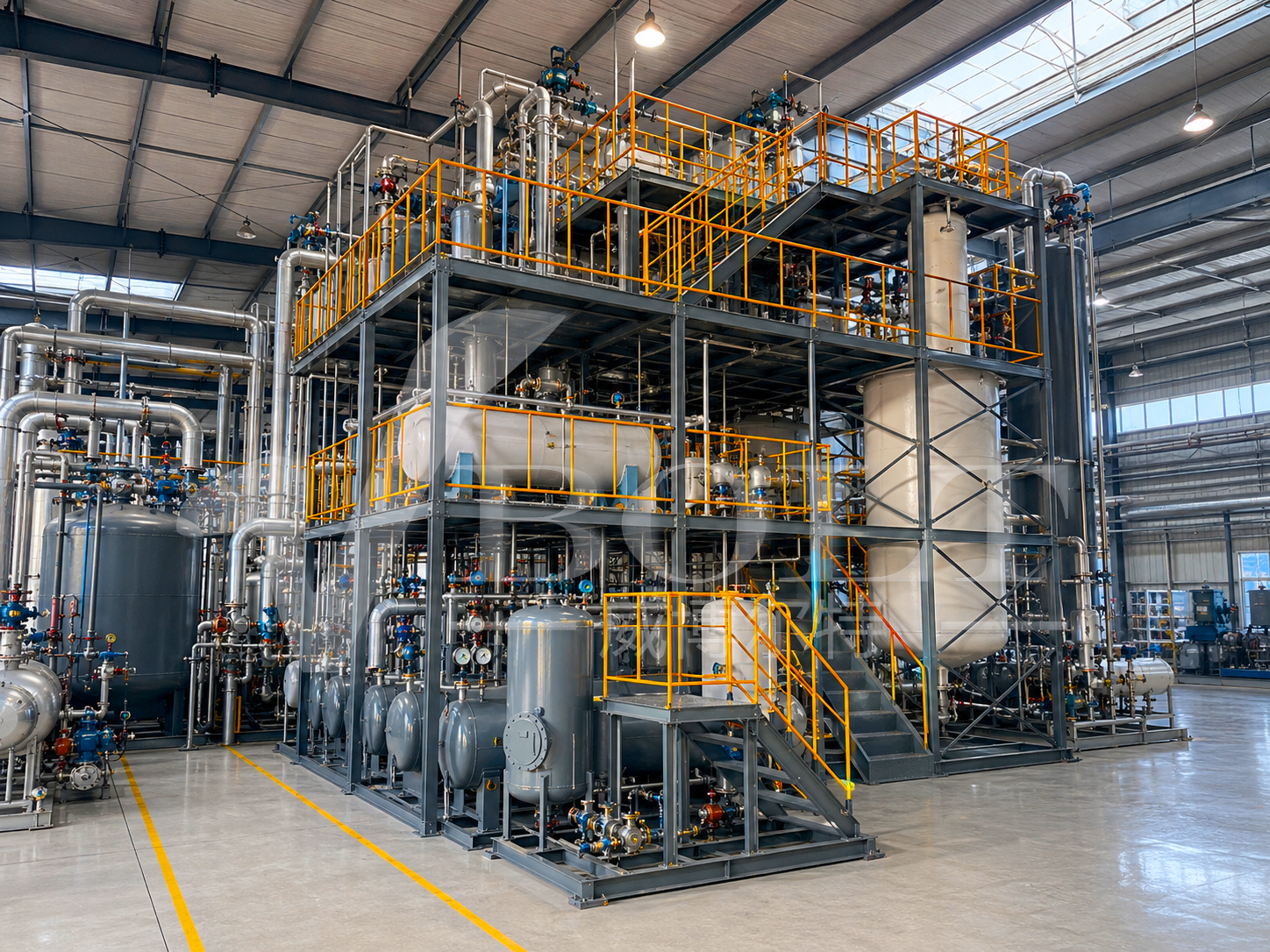
Buyers comparing suppliers should therefore ask:
- What product is the plant actually designed to produce, and from which feedstock?
- Which product cuts are expected, and is downstream finishing included?
- What laboratory specification will be used for final product acceptance?
For fuel-fraction projects, see our Waste Oil to Diesel Distillation Plant.
For base oil projects, see our Used Oil Re-Refining Base Oil Equipment.
Compare the Complete Equipment Scope
The main distillation unit is only one part of an industrial waste oil processing facility.
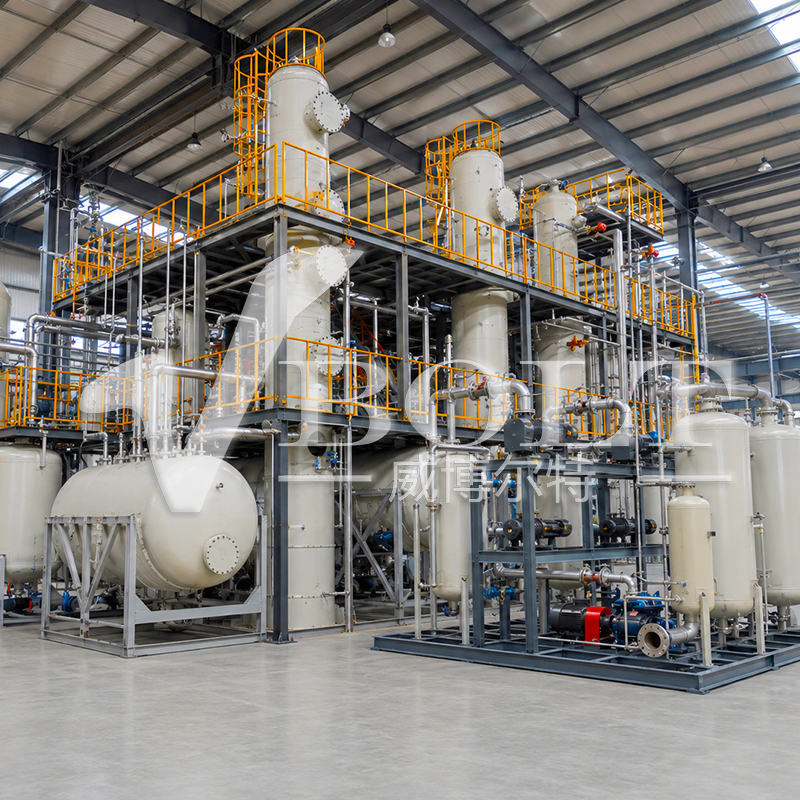
A quotation can differ significantly depending on whether it includes:
- feed receiving, storage and transfer;
- coarse filtration, settling, dehydration and light-end removal;
- vacuum system, distillation, fractionation and condensation;
- product finishing and product storage;
- residue handling and process-gas treatment;
- PLC, instrumentation, laboratory equipment and safety systems;
- installation and commissioning support.
A lower quotation may reflect a narrower equipment boundary.
The problem arises when two different scopes are compared as if they were the same plant.
Our Waste Oil Recycling Plant page recommends comparing proposals using verified feed data and acceptance criteria rather than headline yield claims.
Engineering Capability Matters Beyond Equipment Manufacturing
For a B2B project, manufacturing vessels and installing pumps is only part of the supplier's responsibility.
A project-specific waste oil recycling plant supplier should also be able to work through the engineering inputs that connect the process to the actual site.
| Engineering Area | What Buyers Should Review |
|---|---|
| Feedstock review | Whether the process design is based on representative feed information |
| Process selection | Whether the route matches the intended fuel fraction or base oil target |
| Material balance | Whether feed, recovered fractions and residue are defined on an agreed basis |
| Utility review | Electricity, heating, cooling water, compressed air and other site requirements |
| Plant layout | Equipment access, tanks, maintenance space and process flow |
| Automation | Instrumentation, alarms, interlocks and operator control |
| Project interfaces | Where supplier scope ends and buyer / local contractor scope begins |
| Acceptance basis | How throughput and product performance will be tested |
VBOLT's engineering process starts from five review inputs: feedstock data, target specifications, capacity, utilities and site constraints. Equipment and controls are then configured around the approved process rather than treating every project as the same standard machine.
Manufacturing and Inspection Should Be Verifiable
Supplier capability should be judged on evidence that can be checked during procurement.
Depending on the contract, buyers can request review of:
- company registration and qualification documents;
- manufacturing and assembly facilities;
- material requirements and applicable conformity documents;
- inspection and test plans, including welding and fabrication controls;
- pressure, leak, electrical and functional checks;
- packing and release inspection, including third-party witness points.
For industrial buyers, this is more meaningful than relying on general marketing descriptions such as “high quality” or “advanced manufacturing.”
Compare Installation, Commissioning and Project Delivery
Equipment fabrication is not the end of the project.
Before selecting a supplier, buyers should clarify the post-manufacturing scope:
- layout and foundation information;
- packing, shipping and installation instructions;
- on-site or remote installation guidance and commissioning support;
- operator training, maintenance documentation and spare parts recommendations;
- site-service terms and warranty boundaries.
For international projects, buyers should also clarify who provides local labor, cranes, piping, cables, civil work and utilities before the commissioning engineer arrives.
This is covered in more detail in our Turnkey Used Oil Re-Refining Plant: Complete Equipment Scope, Utilities and Project Delivery.
Performance Claims Need an Acceptance Basis
Statements such as “high yield,” “high-quality oil” or “10 TPD output” are not sufficient for technical procurement unless the test basis is defined.
A meaningful performance commitment should specify:
- the representative feedstock or agreed feed envelope, including feed preparation condition;
- operating hours and utility conditions;
- feed rate and stable operating period;
- sampling method and product cut points;
- laboratory test methods and mass-balance method;
- product acceptance criteria.
This protects both sides: the buyer knows what will be tested, and the supplier is evaluated against the feed and operating conditions the plant was designed for.
Waste Oil Recycling Plant Supplier Comparison Checklist
| Comparison Item | What the Buyer Should Confirm |
|---|---|
| Feedstock | Exact oil type, representative analysis and accepted contaminant range |
| Target product | Fuel-range fraction, recovered lubricant fraction or finished base oil target |
| Capacity | Feed basis, operating hours and sustainable daily throughput |
| Process route | Pretreatment, distillation, fractionation and finishing stages |
| Equipment list | Exactly what is included and excluded |
| Utilities | Electricity, heating, cooling, compressed air and water requirements |
| Automation | PLC, instrumentation, alarms and safety interlocks |
| Site interfaces | Civil work, tanks, piping, cables and local contractor responsibilities |
| Inspection | ITP, testing, documentation and third-party witness points |
| Installation | Who performs erection and who provides local labor and lifting |
| Commissioning | Included support, site readiness and commissioning feed requirements |
| Training | Operator and maintenance training scope |
| Acceptance | Feed envelope, throughput test, mass balance and product test methods |
| After-sales | Spare parts, service response, warranty and ongoing technical support |
This checklist makes quotation differences easier to explain internally to technical teams, procurement managers and project investors.
How VBOLT Builds a Project Proposal
We do not assign a standard plant model only from the requested TPD figure.
Our technical review can follow this sequence:
| Stage | Project Review |
|---|---|
| 1. Feedstock review | Review oil type, source, representative test data and variability |
| 2. Product definition | Confirm target fuel fraction or base oil requirement |
| 3. Capacity basis | Confirm sustainable feed supply, operating hours and production schedule |
| 4. Process selection | Define pretreatment, separation and finishing stages |
| 5. Utility review | Check site electricity, heating, cooling and other utilities |
| 6. Equipment configuration | Prepare the preliminary equipment and control scope |
| 7. Interface review | Define tanks, civil work, piping, electrical and other battery limits |
| 8. Inspection basis | Agree applicable inspection, testing and documentation requirements |
| 9. Delivery planning | Define packing, shipment, installation and commissioning responsibilities |
| 10. Acceptance basis | Define measurable feed, operating and product conditions for final evaluation |
Comparing Waste Oil Recycling Plant Suppliers?
Send us your feedstock information, representative test data, available daily or monthly volume, target product, required capacity, site utilities and the quotations or scope points you are comparing.
We can review the process basis, equipment scope, utility requirements, project interfaces and acceptance conditions required for your waste oil recycling project.
Order & Project Support
Frequently Asked Questions
What should industrial buyers compare between waste oil recycling plant suppliers?
Compare the feedstock basis, target product, capacity definition, process route, complete equipment scope, utilities, automation, inspection plan, installation support, commissioning and acceptance criteria. A price comparison is meaningful only when these project boundaries are comparable.
Is the lowest waste oil recycling plant quotation always the cheapest project?
No. A lower quotation may simply include fewer pretreatment stages, tanks, finishing equipment, controls or project services. Buyers should compare the full installed project scope rather than equipment price alone.
Should a supplier provide a fixed recovery rate before testing the waste oil?
A recovery estimate should be linked to representative feedstock data, operating conditions, product cut points and an agreed mass-balance basis. A fixed percentage applied to every waste oil type is not a reliable basis for project acceptance.
Can one waste oil recycling plant process every type of waste oil?
No plant should automatically accept every liquid described as waste oil. Suitable mineral used oils can be evaluated against the agreed feed envelope, while unknown chemical mixtures, incompatible fluids or regulated contaminants may require separate handling or rejection.
What information should be sent before requesting a waste oil recycling plant quotation?
Provide the oil type and source, representative feed analysis, available volume, target product, required capacity, operating schedule, site voltage, heating source, cooling conditions, installation country and expected installation and commissioning scope.