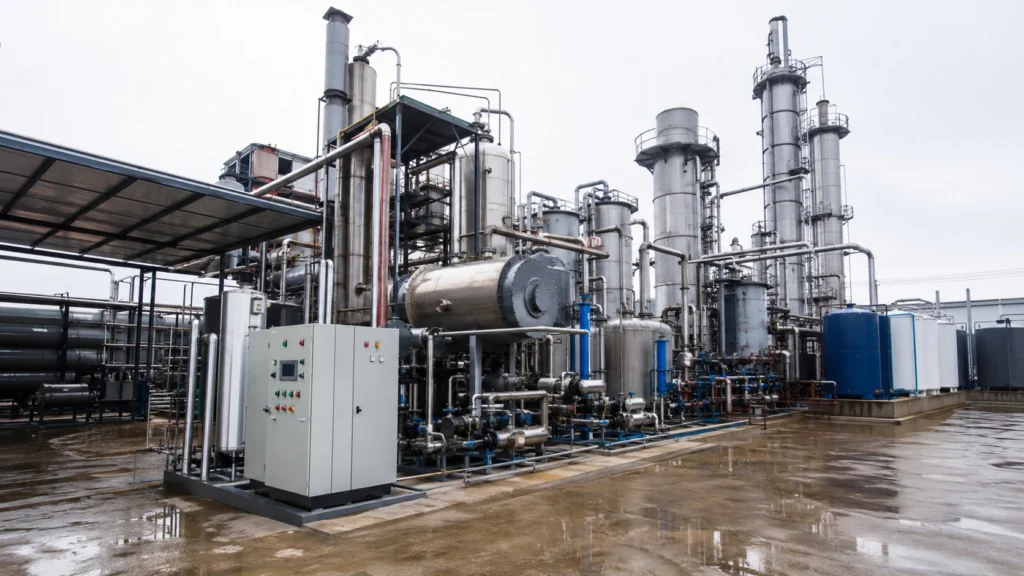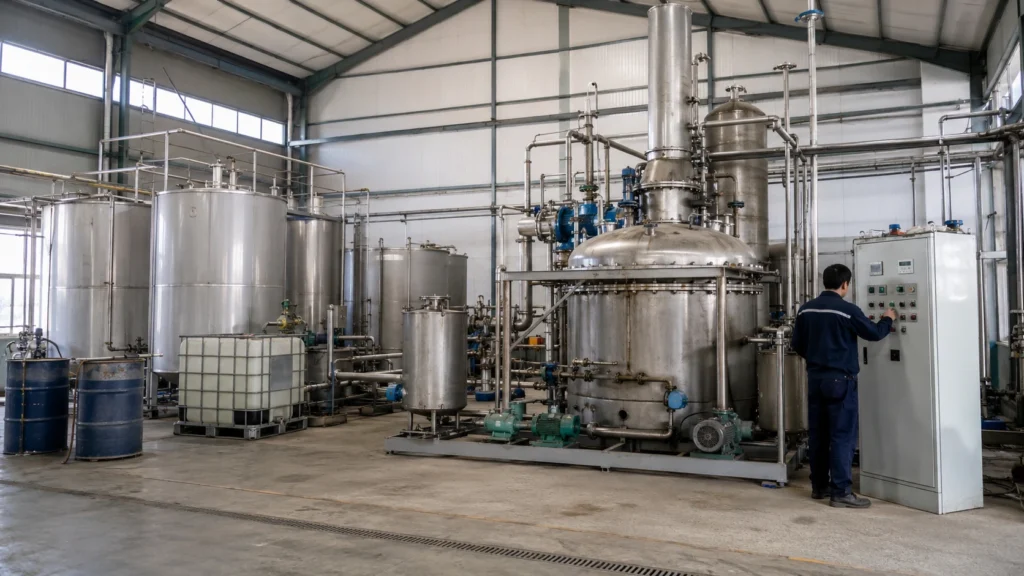






A waste oil distillation plant can have enough nominal capacity and still operate well below its expected daily throughput.
In many existing plants, the restriction begins before distillation. High or inconsistent water content extends pretreatment time, increases the amount of material that must be heated and separated, and can leave the distillation section waiting for prepared feed.
The practical objective of waste oil dehydration is therefore not simply to remove water. It is to supply the downstream distillation system with sufficiently controlled feed at the required rate without allowing pretreatment to become the production bottleneck.
For operators trying to improve an existing plant, four questions matter:
- How much prepared oil does the dehydration section actually deliver each day?
- How much production time is lost while distillation waits for prepared feed?
- Which incoming oil streams create the longest dehydration cycles?
- Can the existing pretreatment section sustainably support the required distillation rate?
These questions provide a more useful basis for improving plant efficiency than dehydration tank volume or nameplate TPD alone.
Table of Contents
▴
Measure Prepared Feed, Not Only Wet Oil Throughput
A common mistake is to measure pretreatment efficiency by how much raw waste oil enters the system.
For the downstream equipment, the more useful figure is:
How much suitable prepared feed reaches the distillation unit during each operating day?
Consider a simplified example. A plant needs 10 tonnes per day of prepared oil for its distillation section. If the incoming oil contains 8 wt% water, approximately 10.87 tonnes of wet feed would be required to provide 10 tonnes before considering solids, sludge, rejected material or other process losses.
This is not a universal design formula. Actual waste oil varies too much for a single number to represent every project. The example simply shows why a 10 TPD pretreatment section and a 10 TPD distillation section should not automatically be assumed to match.
| Operating Measure | What It Tells You |
|---|---|
| Wet oil entering pretreatment | Total incoming material handled by the pretreatment section |
| Water and sludge removed | Material that does not continue to downstream distillation |
| Prepared feed produced | Actual oil available to the distillation section |
| Pretreatment hours per batch | How quickly prepared feed can be supplied |
| Distillation waiting time | Direct indication of lost plant utilization |
| Prepared feed per operating day | Practical pretreatment capacity |
If the distillation unit regularly waits for feed, improving this upstream balance may increase actual production without immediately replacing the main
waste oil distillation plant.
Remove Bulk Free Water Before Using More Energy for Dehydration
Not all water in collected waste oil needs to be handled in the same way.
Some incoming loads contain a distinct free-water layer that can separate during controlled storage or settling. Other feeds contain dispersed or emulsified water that is more difficult to remove.
Where bulk free water can be separated before the heated dehydration stage, doing so reduces the amount of water that the higher-duty pretreatment section must handle.
A practical sequence may be:
receiving → segregation → settling / free-water removal → solids removal → controlled dehydration → prepared-feed storage → distillation
The exact arrangement depends on the feedstock and the existing facility.
The important efficiency point is to avoid using a higher-energy dehydration stage for a separation that could have been completed earlier in the process.
Operators should therefore track:
- how much water is removed during receiving or settling;
- how much is removed during the main dehydration stage; and
- the condition of the prepared oil entering distillation.
If most incoming water is being removed only in the final heated stage, there may be an opportunity to reduce that load before dehydration.
Do Not Treat Every 5% Water Feed as the Same Feed
A laboratory result stating that a waste oil contains 5% water does not describe the complete dehydration problem.
Two oils with similar total water content can require very different pretreatment times.
The difference may come from:
- free versus emulsified water;
- oil viscosity;
- sludge and fine solids;
- lubricant additive packages;
- source of the used oil;
- previous mixing or agitation;
- feed temperature;
- contamination with other liquids.
Relatively consistent mineral-based lubricating oil collected from one industrial source can behave very differently from mixed oil collected from multiple workshops, fleets and factories.
This matters commercially. If one supplier's oil can be prepared quickly while another supplier's material repeatedly doubles dehydration time, averaging both streams into a single monthly water figure hides the actual operating problem.
| Feed Situation | What to Monitor | Possible Operating Decision |
|---|---|---|
| Consistent low-water feed | Normal dehydration cycle and prepared-feed output | Normal processing route |
| Feed with visible free water | Separated water volume and settling time | Improve upstream free-water removal |
| Persistent emulsified water | Heating time, residence time and dehydration performance | Segregate and review pretreatment conditions |
| High sludge or fine solids | Filter loading and pretreatment interruptions | Improve solids removal before dehydration |
| Unknown contamination | Feed identity and compatibility | Hold the load before acceptance |
For plants receiving feedstock from several suppliers, representative testing also helps distinguish a dehydration problem from a broader feed-quality problem. See our guide to
used oil testing before equipment selection
for the main feed properties that should be reviewed.
Keep Difficult Wet Feed From Slowing the Entire Feed Pool
Feed segregation is often treated only as a quality-control measure. In a commercial waste oil processing plant, it can also improve production efficiency.
Consider a facility with enough relatively controlled lubricating oil to keep the distillation system operating, but one incoming tanker contains unusually high water or a persistent emulsion.
If that load is immediately blended into the main raw-oil tank, one difficult tanker can turn a much larger quantity of otherwise manageable feed into a slow pretreatment batch.
Keeping questionable material separate allows the operator to decide whether it should be:
- settled for longer;
- separately dehydrated;
- blended only after compatibility is confirmed;
- subjected to additional testing; or
- excluded from the normal process route.
This is particularly important when collecting used hydraulic oil, gear oil, transmission oil and other industrial lubricants from multiple sources.
Coolant, water-glycol hydraulic fluid, brake fluid, solvents and unidentified chemical mixtures should not simply be treated as high-water waste oil.
A larger dehydration system is not a solution to an incompatible feedstock.
For waste oil recycling equipment, feed acceptance and pretreatment should therefore be considered as part of the same operating strategy.
Match the Dehydration Cycle to Distillation Demand
Even when the dehydration process itself works correctly, poor coordination between pretreatment and distillation can reduce overall plant utilization.
A pretreatment cycle may include:
charging → heating → dehydration → settling → filtration → transfer → preparation for the next batch
If prepared oil is not available when the distillation section needs it, the main equipment must stop or reduce feed.
The more useful capacity measure is therefore:
prepared feed per cycle × achievable pretreatment cycles per operating day
rather than vessel volume alone.
A larger dehydration tank does not necessarily produce more prepared oil per day. If the larger batch also requires proportionally more heating and dehydration time, the gain in practical throughput may be limited.
Before changing equipment size, compare:
- current pretreatment batch size;
- actual cycle time;
- prepared feed produced per batch;
- achievable cycles per day;
- downstream distillation demand;
- hours the distillation section waits for feed.
This shows whether the real problem is equipment capacity, feed condition or simply a mismatch between two process cycles.
Use Prepared-Feed Buffering When the Two Processes Run on Different Cycles
Where pretreatment and distillation do not operate at exactly the same rate, a prepared-feed buffer can help separate the two operating cycles.
The process becomes:
raw waste oil → dehydration / pretreatment → prepared-feed tank → distillation
The prepared-feed tank does not create processing capacity by itself. Its function is to maintain feed availability.
While the distillation unit is consuming previously prepared oil, the pretreatment section can prepare the next quantity of feed.
This arrangement may be useful when:
- pretreatment is batch-based;
- incoming water varies;
- distillation operates for longer production periods;
- several feed sources are processed;
- pretreatment and distillation cycle times do not align.
There is an important limitation.
If pretreatment sustainably produces only 6 tonnes of prepared oil per day while the downstream plant requires 10 tonnes, adding a larger buffer tank merely delays the feed shortage.
The dehydration bottleneck still needs to be corrected.
Avoid Over-Treating Feed That Is Already Suitable for Distillation
Efficiency problems can also occur in the opposite direction.
Pretreatment should have a defined operating objective. Continuing dehydration longer than required simply because “drier is always better” can increase cycle time without creating a useful downstream benefit.
The dehydration endpoint should therefore be linked to:
- the downstream distillation process;
- actual feed characteristics;
- required operating stability;
- the agreed plant design basis.
There is no responsible universal water percentage that should be copied across every waste oil project without considering the process configuration.
Instead of asking only:
“What water percentage can the dehydration machine reach?”
a more useful question is:
“What feed condition does the downstream distillation section require, and can the pretreatment system supply that feed consistently at the required rate?”
This connects dehydration performance directly to plant output.
Track Whether Dehydration Changes Actually Improve Plant Efficiency
After changing feed segregation, free-water removal, dehydration operation or prepared-feed buffering, the operator needs to confirm whether the complete plant has actually improved.
| KPI | Desired Direction | Why It Matters |
|---|---|---|
| Prepared feed per operating day | Increase | More usable feed becomes available to distillation |
| Pretreatment hours per tonne of prepared feed | Decrease | Shows better practical pretreatment productivity |
| Distillation waiting time | Decrease | Directly improves main-unit utilization |
| High-water feed disruptions | Decrease | Shows better receiving and segregation control |
| Stable distillation operating hours | Increase | Shows more productive use of the main equipment |
| Feed-related reprocessing | Decrease or remain controlled | Efficiency should not be gained by sacrificing product stability |
One particularly useful number is:
distillation waiting hours caused by unavailable prepared feed
If this decreases while stable distillation hours and daily prepared-feed volume increase, the dehydration improvements are producing a real plant-level benefit.
When Is Process Optimization No Longer Enough?
Operating changes have limits.
The existing dehydration section should be reviewed for an equipment upgrade when the plant repeatedly shows conditions such as:
- the distillation unit regularly waits for prepared feed;
- high-water feed is a normal part of the feedstock rather than an occasional exception;
- dehydration is consistently the longest stage in the production cycle;
- sustainable prepared-feed output remains below downstream demand;
- planned plant expansion will materially increase required feed supply;
- the current system cannot process the normal feed range within the required operating schedule.
The decision should still be based on the actual bottleneck.
If enough prepared feed is already available but increasing the distillation feed rate causes unstable vacuum or poor fraction control, adding dehydration capacity will not solve the problem.
In that case, the restriction has moved downstream.
What to Prepare Before Requesting a Dehydration Efficiency Review
An equipment supplier can give a much more useful recommendation when the customer provides operating data instead of only asking for a larger machine.
For an existing plant, prepare:
- waste oil types and sources;
- typical incoming water condition;
- highest water condition normally accepted;
- whether water is mainly free or emulsified;
- current pretreatment method;
- pretreatment batch size;
- actual pretreatment cycle time;
- prepared feed produced per day;
- actual distillation feed rate;
- hours the distillation unit waits for feed;
- sludge and solids condition;
- existing raw-oil and prepared-feed tank capacity;
- current actual daily throughput;
- target future throughput.
If the project is also evaluating a larger overall plant, review our
5, 10 or 20 TPD Waste Oil Recycling Plant Capacity Guide
before finalizing the new processing target.
The objective is to distinguish between three very different situations:
an operating problem, a feedstock problem, or an undersized pretreatment system.
That distinction should be made before additional equipment is purchased.
Is Feed Dehydration Limiting Your Waste Oil Distillation Output?
If your existing distillation plant is not reaching the expected daily throughput, compare the sustainable prepared-feed rate with the actual demand of the distillation section.
Send VBOLT your current feed-water condition, dehydration cycle time, prepared-feed output and actual distillation throughput. We can review whether pretreatment is the real capacity restriction and which part of the feed-preparation system should be addressed.
Frequently Asked Questions
Can better dehydration increase waste oil distillation capacity?
It can increase practical throughput when pretreatment is limiting the supply of prepared feed. If the distillation section already receives enough suitable oil, the bottleneck may instead be vacuum, heating, fractionation, condensation or another downstream stage.
Is a larger dehydration tank always more efficient?
No. Daily prepared-feed output depends on batch size, heating time, water condition, filtration, transfer and the complete pretreatment cycle. A larger vessel may not significantly increase throughput if the cycle also becomes longer.
Should high-water waste oil be mixed with drier oil before processing?
Not automatically. Mixing does not remove water and can turn one difficult incoming load into a larger variable batch. Segregation and feed evaluation should come first.
Does free water require the same treatment as emulsified water?
No. Bulk free water may be removable earlier through controlled settling or separation, while dispersed or emulsified water can require a different dehydration duty. Feed condition should therefore be evaluated instead of relying only on total water percentage.
How do I know whether dehydration is the actual plant bottleneck?
Compare sustainable prepared-feed output with the distillation unit's actual feed demand. If the main unit repeatedly waits for prepared oil and pretreatment cannot close that gap within the operating schedule, dehydration or another pretreatment stage is likely limiting plant utilization.